


/file/publisher-c1a3f893382d2b2f8a9aa22a654d9c97/2025/10/e81bc5899ccf3ba1ae01788439f05466.jpg)

Zafrul argues M'sia only needs to mirror US sanctions for 'shared' concerns
Commenting on the clause in Article 5.1, which requires Malaysia to mirror US trade policies against another country, Zafrul asserted that this is only applicable when it also impacts Malaysia.
He highlighted that the text...
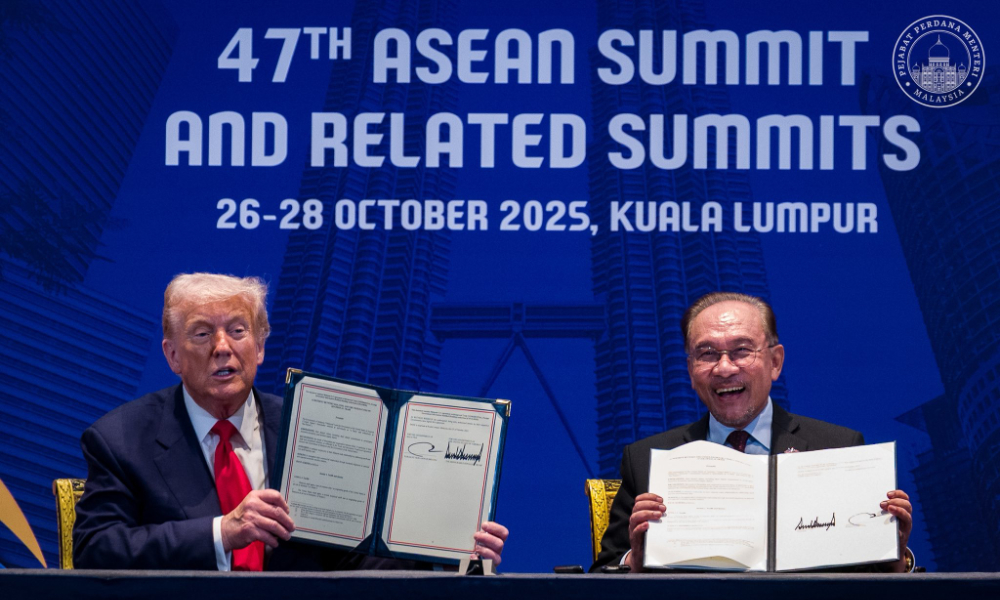
Investment, Trade, and Industry Minister Tengku Zafrul Abdul Aziz has highlighted a caveat in the Malaysia-US reciprocal trade agreement on mirroring sanctions, which he claimed critics have overlooked.
Commenting on the clause in Article 5.1, which requires Malaysia to mirror US trade policies against another country, Zafrul asserted that this is only applicable when it also impacts Malaysia.
He highlighted that the text spells out that such measures are to “address a shared economic or national security concern”.
“The keyword is ‘shared’. If it only affects US economic and national security, but doesn’t impact Malaysia... we don’t need to consider it,” he said in a video posted on social media last night.
He was responding to criticism from former trade minister Azmin Ali, who warned that Article 5.1 could hamper Malaysia’s neutrality and ties with other countries, including China.
The full wording of section 1 in Article 5.1 is as follows:
“If the US imposes a customs duty, quota, prohibition, fee, charge, or other import restriction on a good or service of a third country and considers that such a measure is relevant to protecting the economic or national security of the US, the US intends to notify such a measure to Malaysia for economic and national security alignment.
“Upon receiving such notification from the US, Malaysia shall adopt or maintain a measure with equivalent restrictive effect as the measure adopted by the US or agree to a timeline for implementation that is acceptable to both parties, to address a shared economic or national security concern, guided by principles of goodwill and a shared commitment to enhancing bilateral relations between the US and Malaysia.”
The common consensus of critics and experts who have reviewed the agreement is that this clause is meant to protect US interests, and not shared interests.
When speaking to Malaysiakini for an earlier story, economist Geoffrey Williams said Article 5.1 was a severe clause.
“This is a severe clause which is aimed at stopping transhipment of Chinese goods to undercut market prices, but would also bind Malaysia to impose similar sanctions against China as those imposed by the US.
“It is potentially very serious and reduces Malaysia’s autonomy in trade and investment,” he said.
Likewise, Universiti Teknologi Petronas adjunct lecturer Samirul Ariff Othman said the clause creates a presumption of support for Washington’s policies - but that enforcement is not automatic and gives Malaysia some wiggle room.
Combating origin washing
However, this is not the only clause which could impact China.
Section 2 of the same article requires Malaysia to crack down on companies owned or controlled by other countries operating in Malaysia that export below-market price goods to the US, increase the exports of such goods to the US, or whose actions harm US exports to either Malaysia or other countries.
There is also a clause aimed at combating origin washing, requiring Malaysia to actively prevent other countries from using it to evade US reciprocal tariffs and sanctions.
While non-specific, these clauses seem primarily aimed at China, which the US has accused of using such practices to undermine its economy.
/file/publisher-c1a3f893382d2b2f8a9aa22a654d9c97/2025/10/7e7c35bc9f7bc82251183c6dc4bf2388.jpg)
/file/publisher-c1a3f893382d2b2f8a9aa22a654d9c97/2025/10/501a81d1633596890fbdb49d50bd2c5e.jpg)
/file/publisher-c1a3f893382d2b2f8a9aa22a654d9c97/2025/07/f0b937528bea08ddead4373f89e8f079.jpg)
/file/publisher-c1a3f893382d2b2f8a9aa22a654d9c97/2025/09/7b98e1dee6945a9f0a1e67f504a2ce09.jpg)


Are you sure you want to delete this comment?
This action cannot be undone.